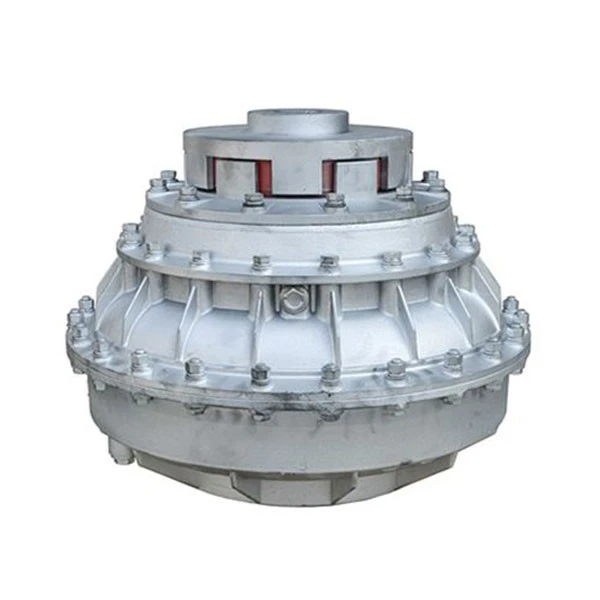
Fluid Coupling

Product Overview


A fluid coupling is a hydrodynamic power transmission device that transfers torque from a driving motor to a driven machine through circulating working fluid (mineral oil or fire-resistant synthetic fluids). By establishing a fluid-based connection between the input and output sides, it enables controlled slip during operation, dampens torsional shocks, and accommodates varying load conditions.
Fluid couplings are engineered for heavy industrial drive systems where smooth acceleration, reduced drive-train stress, and multi-motor load balancing are critical. Depending on operational demands, configurations are available in constant-fill designs for standard squirrel-cage motors or variable-fill (scoop-tube) systems for precise output speed control.
Suitable for belt conveyors, crushers, heavy mills, and large pumps, selection is determined by power rating, input speed, load inertia, starting conditions, and thermal duty cycle.


Key Features and Functional Benefits

Hydrodynamic Torque Transmission

Transmits torque through circulating working fluid rather than a rigid mechanical connection, absorbing torsional shocks and protecting reducers, gearboxes, and conveyor belts from premature fatigue.


Controlled Starting Performance

Moderates the acceleration of high-inertia loads, limiting initial startup torque and preventing high electrical current spikes on weak power grids.

Thermal Overload Protection

Equipped with calibrated thermal fusible plugs that melt at specific temperature thresholds (120°C or 140°C), automatically discharging working fluid to disconnect power during prolonged overloads or stalls. (Note: Requires appropriate containment and system shutdown interlocks).

Multi-Motor Load Sharing

Automatically balances torque distribution across parallel-driven systems without complex electronic synchronization.

Flexible Configurations

Available in constant-fill designs for fixed-speed applications and variable-fill scoop-tube designs for dynamic output speed regulation.


Technical Specifications


Parameter

Specification Range

Power Rating

5.5 kW to 3500 kW

Input Speed

750 RPM to 3000 RPM

Working Fluid

ISO VG 32 / VG 46 mineral oil; HFC water-glycol fire-resistant fluid options

Thermal Protection

Fusible plugs calibrated at 120°C or 140°C

Housing Materials

GG25 cast iron, SG iron (GJS-400-15), or welded steel

Cooling Arrangements

Surface cooling, water-oil heat exchangers, or air-oil coolers

Configuration Options

Constant-fill or variable-fill (scoop-tube) designs

Shaft Connections

Cylindrical bores, keyways, tapers, or splines


Models and Configurations

YOX Series (Constant-Fill)

Standard delayed-action design featuring an internal delay chamber to limit starting torque and extend acceleration time for belt conveyors and crushers.

YOXW Series (Pulley-Type)

Integrated V-belt output hub designed for compact drive layouts and space-constrained installations.

TVV / DST Series (Variable-Speed / Scoop-Tube)

External scoop-tube mechanism allowing dynamic output speed adjustment and load decoupling during active operation.

Explosion-Proof Variants

Configured with spark-resistant bronze components and certified for underground mining (ATEX / Ma-certified atmospheres).


Industrial Applications

Bulk Material Handling: Surface and underground belt conveyors, bucket wheel stackers, and reclaimers.


Mining & Mineral Processing: Heavy-duty crushers, ball mills, rod mills, and apron feeders.


Power Generation: Coal pulverizers, induced/forced draft boiler fans, and feed water pumps.


Cement & Heavy Industry: Kiln drives, centrifugal compressors, and heavy mill systems.


Marine & Special Machinery: Application-specific propulsion and auxiliary drive systems requiring specialized engineering review.

Coupling For Hydraulic Fludex


Coupling For Hydraulics Fludex


Manufacturing and Quality Control

Casting & CNC Machining: Housing components produced via precision resin-sand casting or heavy-duty steel welding, machined on CNC horizontal boring centers to maintain critical tolerances within +/-0.02 mm.


Dynamic Balancing: Rotating assemblies (impellers, pump wheels, turbine runners) undergo dynamic balancing on computerized rigs to ISO 1940 Grade G2.5 standards to eliminate operational vibration.


Pressure & Leak Testing: Every assembled fluid circuit undergoes a 1.5x working pressure pneumatic/hydraulic leak test for a minimum of 30 minutes prior to crating.


Material Traceability: EN 10204 Type 3.1 material test certificates supplied upon request for all pressure-containing components, shafts, and hubs.


Customization Options

Shaft Bore Machining

Custom cylindrical, tapered, or spline bores machined to exact customer drawings and ISO, ANSI, or DIN dimensional standards.

Sealing & Environmental Protection

Specialized fluoroelastomer (FKM) labyrinth seals and corrosion-resistant marine coatings for outdoor, offshore, or corrosive operating environments.

Sensor Integration

Factory-drilled and tapped ports for mechanical or electronic thermal probes, speed sensors, and oil-level monitoring switches.


Frequently Asked Questions


Q: How do I select the correct fluid coupling for my motor and driven machine?

A: Selection requires three primary parameters: motor rated power (kW), operating speed (RPM), and driven machine load characteristics (inertia, starting torque, and duty cycle). Match these values against our thermal power capacity charts, or submit your load profile to our engineering team for dynamic simulation matching.

Q: What is the function of the fusible plug, and how does it protect the system?

A: The fusible plug contains a low-melting-point alloy calibrated to release at 120°C or 140°C. If the coupling experiences a continuous jam or excessive slip, fluid temperature rises rapidly. The plug melts, discharging working fluid into a containment shroud, instantly dropping transmitted torque and safeguarding the motor and downstream machinery.

Q: Can standard constant-fill fluid couplings operate with fire-resistant fluids?

A: Yes. For underground mining or explosion-hazardous environments, couplings can be built with specialized FKM elastomers and certified to operate with water-glycol (HFC) or synthetic fire-resistant fluids instead of standard mineral oil.

Q: What routine maintenance is required during operation?

A: Due to hydrodynamic non-contact power transmission, maintenance is minimal. It requires periodic visual inspection for shaft seal leaks, monitoring operating oil temperature, and checking oil condition and level every 4,000 to 8,000 operating hours depending on duty cycles.

Q: Do you supply matching flexible couplings or connection hubs?

A: Yes. We supply complete drive packages including resilient pin-bush couplings, gear couplings, or bell housings engineered to mount directly between the electric motor shaft, the fluid coupling, and the driven gearbox.

Q: What is the standard lead time for custom bore configurations?

A: Standard catalog models ship within 3 to 5 business days. Custom shaft bore machining, specialized keyways, or non-standard mounting configurations typically require 15 to 25 business days, supported by complete 3D CAD STEP files for layout integration.

We are one of the most professional fluid coupling manufacturers and suppliers in China, specialized in providing high quality products and efficient solutions to global clients. Welcome to buy durable fluid coupling for sale here from our factory. For price consultation, contact us.

fluid coupling, Flender Fluid Coupling, Voith Fluid Coupling

(0/10)

clearall